In May 2022, thousands of cases of monkeypox, a disease commonly found in central and west Africa, were confirmed in Europe, the U.S. and other non-endemic countries. This outbreak led to false or misleading claims spreading online about the virus, often pushed by well-known purveyors of health misinformation.
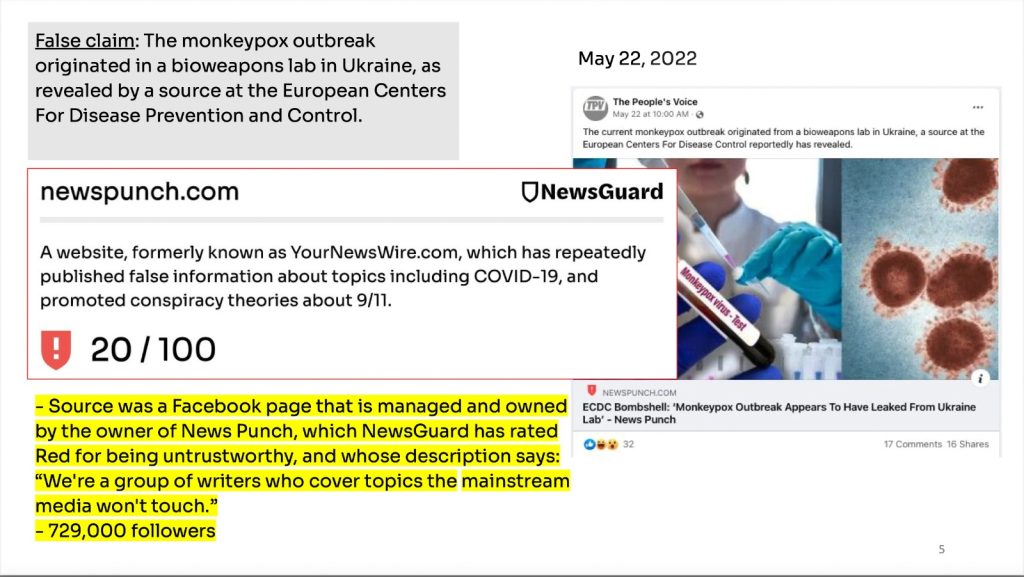
In this report, NewsGuard features monkeypox false claims that have been shared in English, French, Italian and German to over 3.8 million people on Facebook (pages and groups) and Twitter, between May 21 and June 13, 2022.
The sites whose false claims were shared on large groups and pages on social media included:
– 100PercentFedUp.com and Expose-news.com in English.
– FranceSoir.fr and LeMediaen442.fr in French.
– NoGeoingegneria.com and DatabaseItalia.it in Italian.
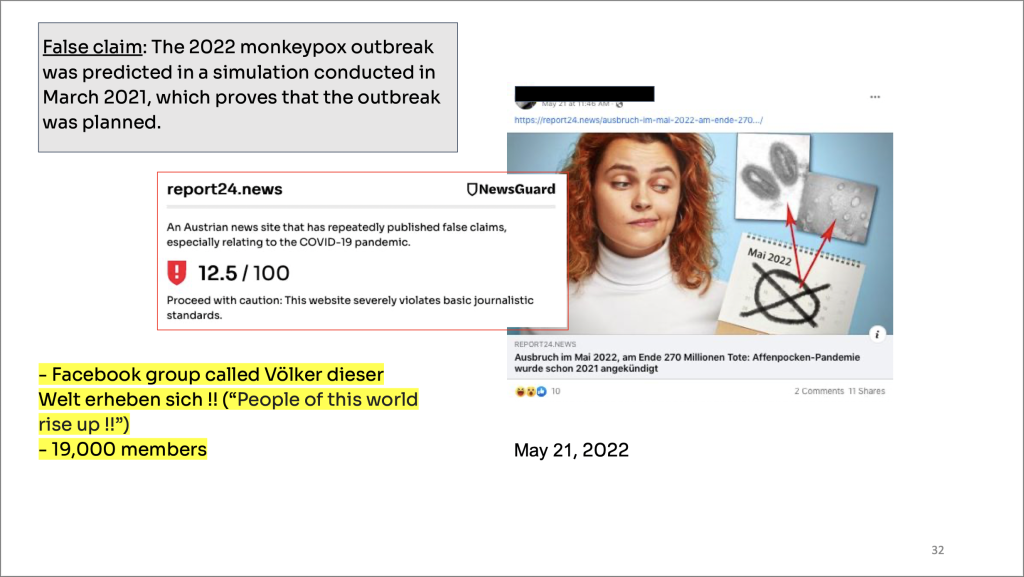
– Compact-online.de and Wochenblick.at in German.
These sites have all have long been identified by NewsGuard as repeatedly publishing false information.
The Myths:
Common myths about the 2022 monkeypox outbreak spreading on social media – all of which are listed in NewsGuard’s Misinformation Fingerprints dataset – include:
– The monkeypox outbreak was caused by a lab-created virus.
– Monkeypox cases are linked to COVID-19 vaccines.
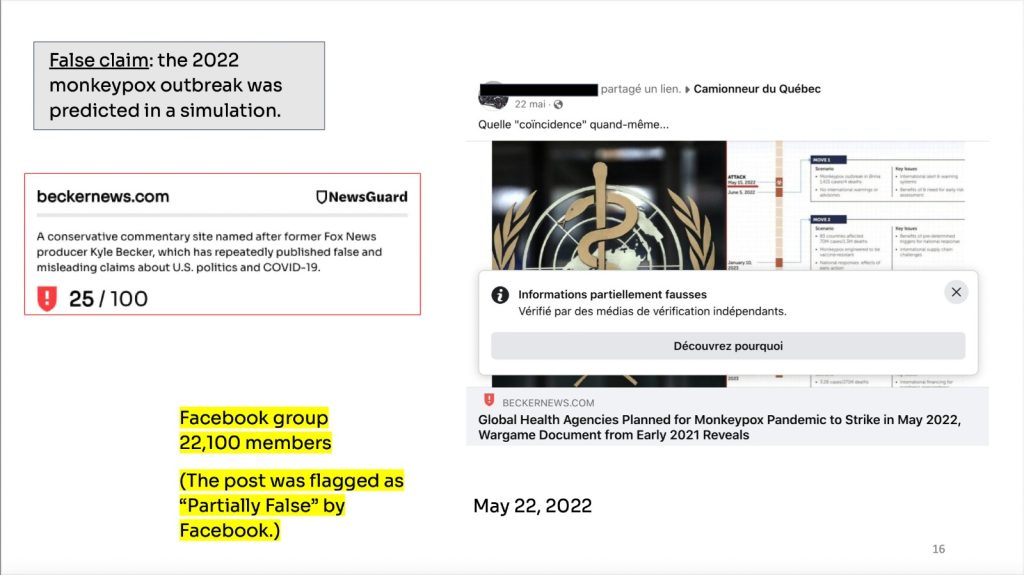
– The 2022 monkeypox outbreak was predicted in a simulation.
– Bill Gates predicted the outbreak.Many are similar to early COVID-19 myths, using in some cases the exact same narratives and characters.
While some posts were flagged as false or partially false on social media platforms, others (at times, the exact same claim, but coming from another source) went completely unchecked.

Read HERE the full report
– This report was produced using two proprietary datasets from NewsGuard: The Misinformation Fingerprints dataset, a catalogue of data about top misinformation narratives, contains related keywords and search terms for all of the top misinformation and disinformation narratives spreading online – produced using human intelligence but designed for use with AI/ML/NLP tools to identify content matching specific false claims. NewsGuard analysts used the Misinformation Fingerprints dataset to identify relevant searches related to misinformation narratives about monkeypox.
– The second dataset used was the News Website Reliability Ratings, which consists of credibility ratings for over 7,500 news and information website that account for 95% of online engagement with news in the U.S., U.K., France, Germany, Italy, and Canada. Each site’s rating is based on nine basic, apolitical journalistic criteria. Based on the criteria, each site receives an overall designation of green (generally trustworthy) or red (generally not trustworthy) and a trust score of 0-100. NewsGuard’s analyst used the News Website Reliability Ratings dataset to identify misinformation sources that appeared in the results for searches conducted as part of the analysis.
– Examples selected for the report represent an illustrative, but by no means exhaustive, list of false claims shared on social media. Both the Misinformation Fingerprints and the News Website Reliability Index are available to be licensed for research and other purposes.